
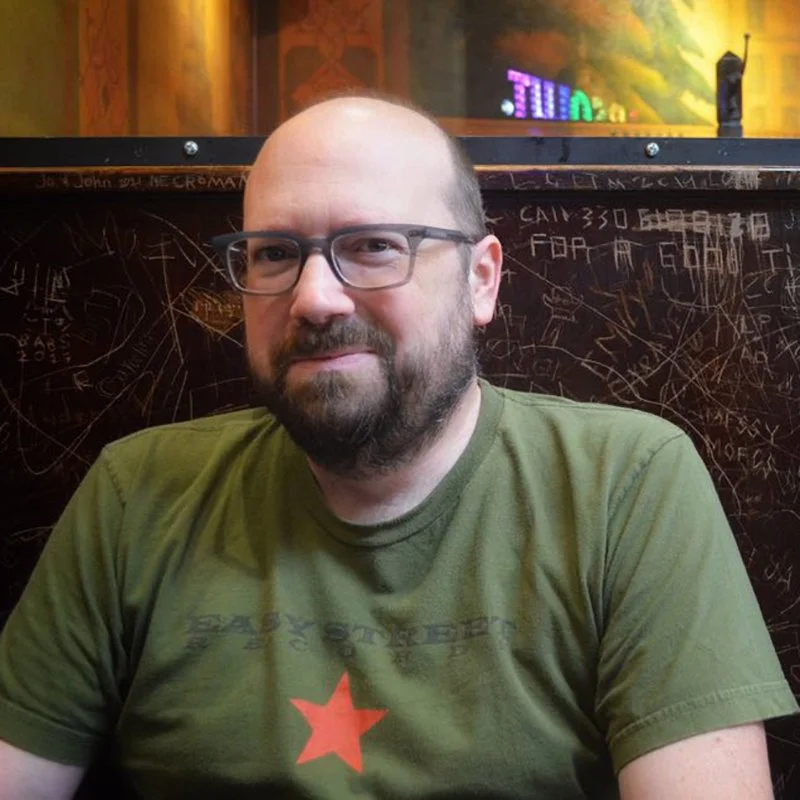
Scott Silsbe
Traffic Jam
Bio: Scott Silsbe was born in Detroit in 1978. He completed his undergraduate studies at Western Michigan University and obtained an MFA in Poetry from the University of Pittsburgh. His poems and prose have been published in magazines and online publications, including Third Coast, Nerve Cowboy, and Lilliput Review. Silsbe is the author of four poetry collections: Unattended Fire (Six Gallery Press, 2012), The River Underneath the City (Low Ghost Press, 2013), Muskrat Friday Dinner (White Gorilla Press, 2017), and Meet Me Where We Survive (Kung Fu Treachery Press, 2022). He is at work on a new collection of poems, as well as a book of music essays. Silsbe is also currently the editor of Low Ghost Press. He works as a bookseller and lives in Wilkinsburg, Pennsylvania.
Facebook: https://www.facebook.com/scott.silsbe.9
Instagram: https://www.instagram.com/scottmsilsbe/
Statement: Because I have not had a lot of experience writing ekphrastic poems, I found the project of creating a poem for the “Traffic Jam” film to be a challenge—however, in the end, I found it very rewarding. The first step for me was to watch the film multiple times and jot down notes—whatever came to mind, really. A sort of free-wheeling association game. I scribbled “movement through time” and “rhythm, strum” and “all the windows witness this.” Some of the film inspired longer phrases in my notes like “It is always at this time of day…” and “Here we are again in the afternoon sprawl.”
Once I had several pages of notes, I set to the task of making the poem. One of the challenges for me was to ground the poem in the narrative of the film, but not simply describe what takes place on-screen. So I had to spend some time reflecting on what a traffic jam like the one in the film means or represents in a broader sense. I knew that I wanted to talk about time and space, as it was obvious to me that one thing that happens when traffic builds up like this is that time slows down in a way. The space we are occupying with others in the world has become more limited and, in a way, the world has forced us to embrace a slower speed.
Because the concept of “space” had introduced itself, it wasn’t long before I thought of the French philosopher Gaston Bachelard—whose writing I’ve found to be an inspiration for many years. To me, it was a natural move in the fourth stanza to talk about the intersection and the traffic jam from above—as that’s where we, the viewer of the film, see it from. But the move that I made in the eighth stanza regarding sitting next to a window and “reverie” is very much influenced by Bachelard and his ideas about “the poetics of space.” It occurred to me that sitting and watching the traffic jam, and filming the traffic jam, were other ways that time was being slowed down—only for the overhead observer, not just the travelers in their vehicles waiting for the traffic to free up.
The most rewarding part of writing for me is the moment of discovery—when, through the process of trying to say something, I find myself articulating a truth I didn’t know. This happened while I was writing my “Traffic Jam” poem—one thing led to another and I had a revelatory moment. About midway through the poem, in the midst of my Bachelardian reverie about time and space, I found myself reflecting on how the spaces that we establish for ourselves—the literal rooms with their windows and tables and chairs—influence the art we make. And, to take it one step further, the art we create—the poem, the film, the song—is its own sort of “space,” its own room. And this room, this newly created entity in the world, is a presence all its own that has its own influence on how the world exists. That is one reason that I love to experience art and one of the main reasons I continue to make it.